Right now, there is considerable uncertainty and complexity around global BEV regulations- we look at the current state of play across three key regulatory environments – the US, China and Europe.
CARB Advanced Clean Cars II
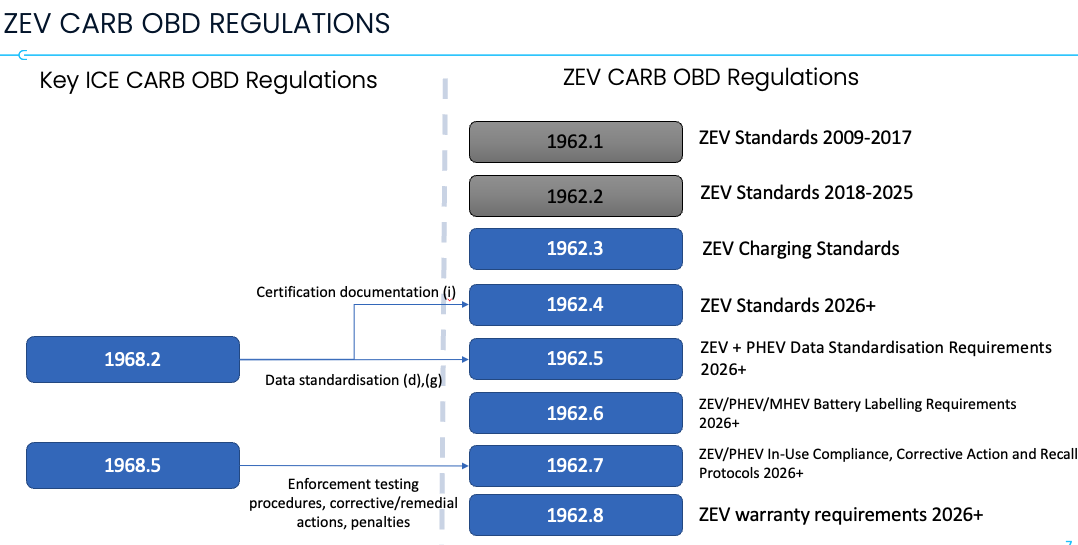
CARB requirements for BEV vehicles are defined in 1962 Advanced Clean Car II Regulations (ACC II). Although this is currently under legal challenge to be enforced by CARB - more on this to follow.
Expected phase in timing:
- 40% of 2026 ZEVs
- 100% of 2027+ ZEVs
BEV OBD requirements cover two main areas:
1. Data Stream Requirements
a. J1979-3 (ZEVonUDS) is the communication standard for all ZEVs and external test equipment as required in ACCII
b. 1962.5 defines a data stream list that must be output by any BEV or PHEV vehicle
c. The SAE J1979DA (digital Annex) contains all the detail of the necessary signals (PIDs) required
2. Propulsion Related Component Monitoring
a. Any component related to vehicle propulsion must be monitored and fault codes output via the OBD port following SAE J1979-3 (ZEVonUDS) / J2012 Standards
China - China7 BEV OBD regulations
Please note that the information below is our current interpretation of the regulations as these remain draft and have yet to be released.
Implementation date: Q1 2028 to Q1 2029
Regulation overview
China 7 BEV requirements are similar to CARB ACCII requirements, with some specific additions:
- On-board terminal needs to meet GB/T32960.2
- Additional environmental PIDs required to monitor battery performance under different conditions
- Comprehensive OBD component monitoring
Additional malfunction criteria
It is proposed that the below will require a Malfunction Indicator Lamp (MIL) in the event of an error:
- Output torque reduction more than 30%
- After fully charged and running WLTC, electronical energy consumption per unit mileage increase more than 15%
- Charge fail or charge performance decreased
- Regeneration function fail or performance decreased
- State of health calculation precision decreased
- Thermal management performance decreased
Reporting - All data must be reported back to a national platform through over-the-air communication.
European Union Euro7 BEV OBD regulations
Implementation date: Q3 2026
Regulation overview
- New minimum battery performance monitors
- 80% performance after 5 years from start of life or 100,000km
- 72% performance after 8 years from start of life or 160,000km (new FUL)
- Monitoring is measured in usable battery energy (UBE)
- On board fuel consumption monitoring (OBFCM) for energy consumption to monitor for sudden or significant changes in battery performance and raise appropriate driver warnings
- Onboard test procedures to determine the rate of charge and discharge to return a value for UBE
Reporting: Data must be reported back to the manufacturer who is responsible for depersonalising and relaying onto a national body.
What happens next?
We’ll continue to monitor global OBD requirements, and the CARB situation in particular, and will provide more information as the situation becomes clearer. Also, look out for our forthcoming article on ZEVonUDS.
Need support with BEV OBD regulations? We are experts in cutting edge automotive diagnostics and ensuring adherence to global regulation.
To find out more, please get in touch at [email protected].